Knighthood - RPG Knights
- 4.5
- Rating
- 5.00M
- Installs
- Free
- Price

 Analysis by App-foxy
I spent time with Knighthood - RPG Knights as a mobile role-playing game built around the fantasy of becoming a medieval knight. Its basic appeal is easy to understand: you are not simply watching a hero grow stronger, you are working toward a personal sense of knighthood through battles, equipment, and gradual advancement. That focus gives the game a clearer identity than many fantasy RPGs that throw a huge world at you before explaining why you should care.
My first impression was that it is designed for short, repeatable sessions rather than one long uninterrupted adventure. I could make progress in a few minutes, then return later with a better weapon, a new objective, or a reason to test myself against a tougher opponent. That rhythm suits a phone well, although it also means the game is constantly asking me to think about what to upgrade next and whether I want to keep pushing or stop before the next hurdle.
It is a free game from RPG Raid Roleplaying Games, classified as a role-playing title and rated Teen. The game has built a substantial audience, with an average rating of 4.5 from around 168 thousand ratings and over 5 million installs. Those figures do not guarantee that every player will enjoy its pacing, but they do reflect that the knight-focused format has found a broad mobile audience.
You May Also Like

 Blood Strike: 2.5 Anniversary
Blood Strike’s Loadouts Turn Every Drop Into a Tactical Gamble
A close look at Blood Strike’s custom loadouts: how fast access to signature weapons reshapes its battle royale rhythm, rewards preparation, and narrows the gap between fights.

 Pandora - Music & Podcasts
Pandora’s Music Is Easy to Start, but Harder to Recover
Pandora’s strength is its low-effort path from a seed to a station. Its weak spot is how much confidence it asks you to place in connection, setup, and quiet recovery.

 8 Ball Pool
 Is Built on Rivalries, Rematches, and Routine
A close look at the rivalries, rematches, shared routines, and unanswered safety questions that turn a quick pool match into a persistent mobile community.

 Samsung Music
’s Quiet Strength Is Playing What You Already Own
Its reach comes less from spectacle than from dependable access to a personal library. That simplicity is both the app’s strongest retention engine and its ceiling.

 AccuWeather: Weather Radar
AccuWeather Review: A Quick, Clear Forecast for Everyday Decisions
For everyday plans, the best forecast is the one you can understand quickly. AccuWeather makes rain timing, radar, and local conditions easy to act on, with a few trade-offs.

 Hill Climb Racing
Why Hill Climb Racing Still Turns Crashes Into One More Run
A tiny car, a bumpy hill and one more upgrade: Hill Climb Racing keeps resurfacing because its simple chaos makes every near-miss feel personal.
More From Our News Desk
View All News


How the first goals shape the experience
The opening hours work best when I treat them as a chain of small knightly assignments instead of expecting a traditional console-sized campaign. A new player needs immediate direction, and the game provides that through the straightforward promise of improving a fantasy warrior. Winning a fight, strengthening a piece of equipment, and preparing for the next encounter create a practical loop: play, assess the reward, make a choice, and return to combat.
That loop is more important than the medieval setting by itself. Swords, armor, and heroic language can make a game look familiar, but the early goals determine whether I feel involved. Here, the useful question is rarely “what is the entire story?” Instead, I find myself asking, “what is the next improvement that will make my knight more capable?” For mobile play, that is a sensible starting point because it gives me something concrete to do even when I only have a short break.
I recommend resisting the temptation to upgrade everything immediately. Early resources feel more valuable when I connect them to a specific obstacle. If a battle exposes a weakness, I can use that information to decide whether my next investment should improve attack, survivability, or general readiness. This is one of the more practical ways to avoid wasting progress: make the opponent reveal the problem before spending heavily on a solution.
The game is also easier to enjoy when I accept that not every reward will feel equally exciting. Role-playing games often provide a steady stream of equipment or improvement opportunities, but a new item is only useful if it supports the way I am currently playing. I found that comparing rewards by their actual effect, rather than by their appearance or novelty, keeps the progression from becoming a cluttered collecting exercise.
For a friend who likes clear goals, this beginning is approachable. For someone who wants immediate freedom to explore a large open map, it may feel narrower than expected. The medieval knight theme is strong, but the early experience is primarily about building a capable combatant, not wandering through an unrestricted world and inventing your own adventure.
What progress feels like after the novelty fades
The strongest progress signal is the changing relationship between my knight and the battles ahead. A fight that once demanded caution can eventually become manageable, and that difference is more satisfying than a number rising on a screen without a visible effect. When an upgrade allows me to handle an encounter with better timing or less risk, I feel that I made a meaningful decision rather than merely collected another reward.
I also pay attention to the way each session answers a simple question: did I move closer to the next useful milestone? If the answer is yes, even a short play period feels worthwhile. If the answer is unclear, the game can start to feel like maintenance. That distinction matters because this is not the kind of RPG I would recommend playing passively. I get more from it when I enter with a small plan, such as improving one part of my build or clearing a particular challenge.
A helpful habit is to separate immediate progress from long-term ambition. Immediate progress might be preparing for the next fight, while long-term progress is shaping a knight that feels consistently reliable. When I focused only on the next reward, I was more likely to make impulsive choices. When I kept the broader direction in mind, equipment decisions became easier to judge. This is a small but important trade-off: chasing every short-term gain can leave the overall build feeling unfocused.
The progression is therefore most rewarding for players who enjoy incremental improvement. I would not call it a game about dramatic reinvention every few minutes. Its pleasure comes from noticing that repeated attention has made difficult content more approachable. If you prefer role-playing games where every chapter completely changes your abilities, the steady pace may seem conservative.
Another useful point is that progress does not automatically remove the need for judgment. A stronger knight can still be poorly prepared, and a reward that looks attractive can be less valuable than one that solves a current weakness. I found that the game rewards observation more than blind upgrading. That makes it more engaging than a simple sequence of tapping through rewards, provided I take the time to understand why a battle went badly.
Where the challenge becomes meaningful
The difficulty curve is most interesting when the game stops allowing me to rely on the same comfortable approach. Early victories can create confidence, but later resistance tests whether my equipment choices and combat habits are actually working. I appreciate that kind of pressure because it turns progression into a decision-making problem. The answer is not always to play longer; sometimes I need to prepare more intelligently.
My advice is to treat a defeat as information rather than as a command to spend immediately. First I look at what happened. Did I lack damage, fail to survive long enough, or simply approach the encounter without enough preparation? That short pause prevents a common mobile-RPG mistake: reacting to frustration by making an expensive upgrade that does not address the real issue.
The challenge can also expose the limits of the format. When a game asks me to repeat earlier activity to become ready for a new obstacle, the process is acceptable if I can see a clear purpose. It becomes tiring when the repetition feels disconnected from a decision. Knighthood works best when I understand what I am training for. Without that context, the same loop can feel less like knightly preparation and more like waiting for permission to continue.
This is where the game differs from some traditional role-playing alternatives. A larger, story-heavy RPG may offer more exploration, dialogue, and dramatic variety, while this title concentrates more tightly on the growth of the knight. That concentration makes it easier to play in brief sessions, but it also means the combat-and-progression loop carries much of the responsibility for keeping me interested.
I would skip it if my ideal RPG is built around unrestricted exploration, deep party management, or a long uninterrupted narrative. I would also be cautious if I dislike repeating activities to strengthen a character. On the other hand, players who enjoy testing a build against increasingly demanding encounters will probably understand the appeal quickly.
Keeping momentum without letting the game control the schedule
The retention pressure comes from the natural temptation to complete just one more objective. Because improvements are divided into manageable steps, stopping can feel slightly premature. I have often reached a point where the next battle looked close enough to attempt, even when a short preparation session would have been wiser. That is effective design for engagement, but it is also something I consciously manage.
I recommend setting a simple stopping rule before playing. For example, I might finish one meaningful objective, make one deliberate upgrade, and then leave. This keeps the game useful during a commute or a short break without turning every spare moment into another round of preparation. The rule is especially helpful in a free-to-play RPG, where the desire to accelerate progress can become part of the experience.
The presence of optional purchases is worth considering before downloading. The game is free to start, with in-app purchases ranging from $0.99 to $99.99 per item. I do not view that range as automatically negative, but it does mean I would approach the store carefully and decide in advance whether I want to spend anything. Players who prefer a completely purchase-free progression path should be prepared to judge the game on its ordinary pacing rather than on shortcuts.
That financial choice changes the best way to play. If I am willing to spend, I still think it is better to identify the exact frustration first instead of buying impulsively. If I want to remain free-to-play, patience and focused upgrades become more important. In both cases, the game is easier to enjoy when purchases are treated as optional decisions rather than as part of the basic definition of success.
There is also a social expectation created by a large player base. With around 11 thousand written reviews, the game clearly encourages strong reactions from its audience, both positive and critical. I would not use popularity alone to decide whether it fits me. The more useful test is whether I enjoy the central rhythm of fighting, improving, and preparing for the next obstacle. No amount of community activity can make an unwanted loop feel satisfying.
Practical advice for different kinds of players
For a new player, I would begin by learning what each reward changes before committing resources. I would avoid upgrading simply because an item is new, and I would keep a small mental note of the kind of opponent that gave me trouble. This creates a feedback loop between combat and preparation, which is where the game has more depth than its simple medieval premise suggests.
For someone playing during everyday downtime, the best scenario is a predictable break: a few minutes before an appointment, during a commute as a passenger, or while waiting for food. I can complete a small task and stop without needing to remember a complicated chain of events. The trade-off is that a longer session may expose repetition more clearly, so I would not choose it as my only evening game unless I genuinely enjoy incremental character building.
For a player returning after time away, I would not immediately spend stored resources or change everything. First I would check what the current obstacle is, replay enough to understand the rhythm, and then make one adjustment. Returning players often feel pressure to catch up quickly, but a rushed rebuild can create more confusion than progress.
For younger players, the Teen rating is an important part of the choice. Parents should also consider the in-app purchase range and whether the device user understands that free installation does not mean every optional item is free. The game may be suitable for someone who enjoys fantasy combat, but the spending conversation should happen before play rather than after an unexpected purchase.
For competitive-minded RPG fans, the question is whether personal optimization is enough to sustain interest. I found the most satisfaction in solving my own progression problems, not in treating every reward as a race. If I need constant direct competition or a highly elaborate tactical system, another role-playing game may be a better match.
Version, access, and the long-term verdict
The current version is 2.7.0, and the game supports devices running Android 6.0 or newer. That makes it accessible to a wide range of Android users, although actual comfort will still depend on the age and performance of the phone. On a smaller or older device, I would pay attention to how easily I can read equipment information and judge upgrades, since those decisions are central to the experience.
Knighthood earns its place as a mobile RPG by keeping its promise focused: build a knight, face fantasy battles, and turn gradual preparation into visible improvement. Its best quality is not simply the theme; it is the way the theme gives purpose to the upgrade loop. I always know what kind of fantasy I am pursuing, even when the immediate task is as ordinary as preparing for the next encounter.
Its main weakness is equally clear. The same focused loop can become repetitive if I do not enjoy revisiting activities or making small optimization choices. The game does not replace a deep, exploration-led RPG, and it is not the right pick for someone who wants every session to deliver a major story revelation. Its free-to-play structure also asks me to be disciplined around optional purchases and around the urge to accelerate every delay.
My final recommendation is simple: choose it if the idea of steadily forging a stronger mobile knight sounds satisfying, not merely attractive in a screenshot. I would recommend it to players who like short sessions, clear objectives, equipment decisions, and a challenge curve that encourages preparation. I would skip it for friends who want a huge world, a tightly authored adventure, or minimal repetition.
After playing it, I see the progression as a test of patience and judgment more than a race toward a final reward. The early goals pull me in, the changing difficulty gives upgrades a reason to exist, and the optional spending makes self-control part of the experience. That combination will not suit everyone, but for the right player it creates a dependable medieval RPG routine. Knighthood - RPG Knights is at its best when I play with a plan, improve with a purpose, and stop because I have reached a satisfying milestone rather than because the game has convinced me that I must continue.
FAQs for Knighthood - RPG Knights
01What is Knighthood - RPG Knights about?
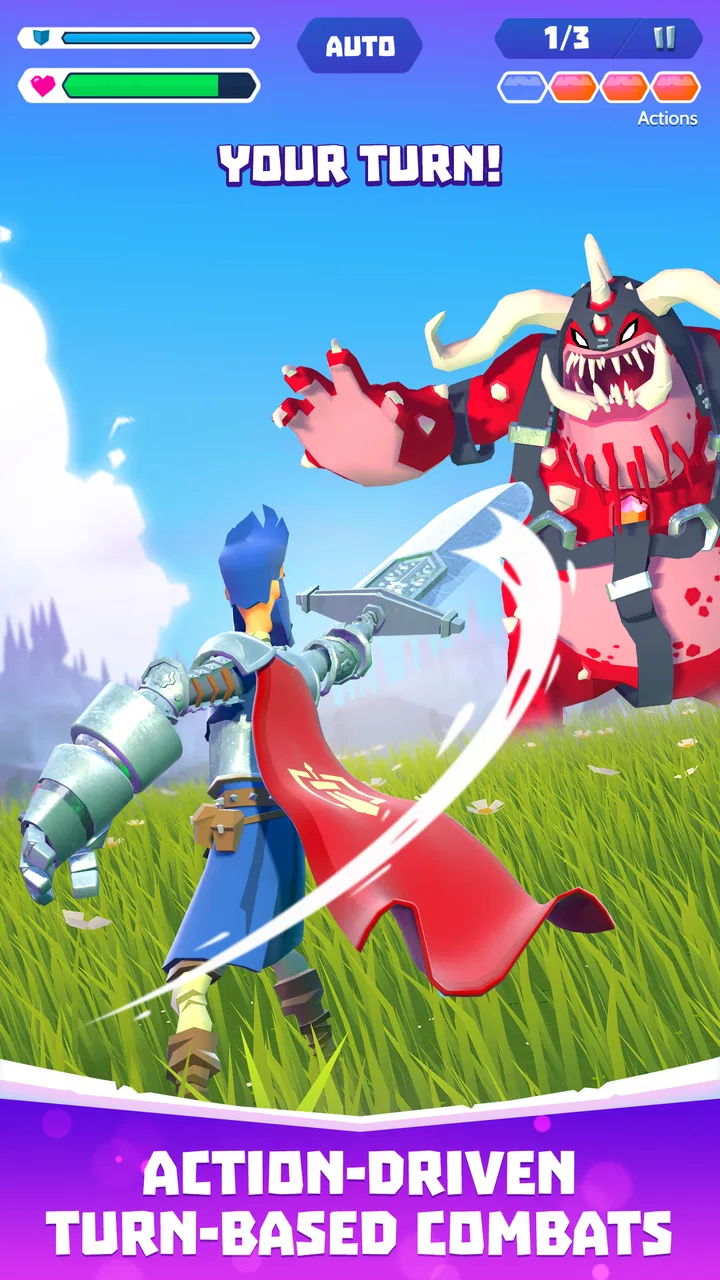
Knighthood - RPG Knights is a mobile role-playing game centered on a customizable knight who travels through a fantasy world, battles monsters and rival warriors, and completes story-driven quests. Combat combines turn-based decision-making with tap-based attacks, weapon abilities, and powerful gauntlet punches. The game also includes equipment upgrades, hero collection, guild activities, and exploration across different regions.
02Is Knighthood - RPG Knights free to download and play?
Yes, Knighthood - RPG Knights is free to download and play on supported Android and iOS devices. However, it includes optional in-app purchases that can provide resources, premium currency, equipment, or progression benefits. You can advance without paying, but progress may require more time and repeated battles, especially when upgrading gear or competing in more demanding events and player-versus-player content.
03Does Knighthood - RPG Knights require an internet connection?
Knighthood - RPG Knights generally requires an active internet connection because several important features depend on online services. This includes account synchronization, events, guild activities, competitive modes, purchases, and some progression systems. Although certain parts of the game may appear playable briefly without a stable connection, offline access is limited, and an uninterrupted connection is recommended for the complete experience.
04How does combat work in Knighthood - RPG Knights?
Combat uses turn-based encounters, but it is more interactive than a traditional menu-driven RPG. You tap enemies to build attack chains, manage your weapon and armor abilities, choose when to use hero powers, and activate the gauntlet for special strikes. Timing and target selection matter, particularly against enemies with shields, weaknesses, or dangerous abilities, so battles reward planning rather than automatic play alone.
05Is Knighthood - RPG Knights suitable for casual players?
Knighthood - RPG Knights can suit casual players who enjoy short battles, character customization, and gradual progression, since daily tasks and quest objectives can be completed in manageable sessions. Nevertheless, the game has many systems to learn, including equipment rarity, hero development, guild participation, events, and competitive modes. Players who want the strongest builds may encounter grinding and pressure to manage resources carefully or consider optional purchases.
Pros
- Stylish comic-book visuals make battles and menus easy to follow.
- Turn-based combat is simple to learn but rewards timing and planning.
- Many heroes offer different abilities and team-building possibilities.
- Frequent events provide extra quests
- rewards
- and limited-time challenges.
- Equipment upgrades give long-term goals beyond simply leveling characters.
Cons
- Energy limits can interrupt longer play sessions.
- Progress may feel slow without regular resource management.
- Some upgrades rely heavily on random loot drops.
- Online features require a stable connection to play reliably.
- The interface can feel crowded for new players at first.

Knighthood - RPG Knights
Gallery